Author Archives: Marciam

Broadway Baker: Keeping Family Memories Alive and Helping Others

Broadway Baker's Lemon Raspberry Shortbread Cookies

Broadway Baker’s Lemon Raspberry Shortbread Cookies

I discovered Broadway Baker (www.broadwaybaker.com) at a Williams-Sonoma Artisan Market in Manhattan.  These Artisan Markets showcase local artisan food producers.

Jim Osorno, owner of Broadway Baker, was a singer and dancer on Broadway before devoting himself to another passion — baking.  His company bakes a variety of cookies, brownies, and cupcakes to order.  A Carrot Raisin Oat Mini-Loaf and granola round out Broadway Baker’s product line.  At the Artisan Market, I purchased the Lemon Raspberry Shortbread Cookies and they were great.

Grandma's Mix-Up Bars from Broadway Baker

Grandma’s Mix-Up Bars from Broadway Baker

Growing up, Jim was always in the kitchen, baking and cooking with his parents and grandmother.  A lot of the recipes he uses today were his mother’s and grandmother’s that he added his own twist to.  For example, the Lemon Raspberry Shortbread Cookies are based on his grandmother’s Shortbread Cookie recipe — to which he added lemon zest and raspberry preserves.  One of his favorite treats as a child was his grandmother’s “Mix-Up Bars.” And “Grandma’s Mix-Up Bars” are one of his brownie offerings now.  A homemade graham cracker crust is topped with semi-sweet chocolate, unsweetened coconut, and crushed pecans, then the bars are drizzled with a sweet cream glaze.  His “Mom’s Granola” is based on the granola that his mother prepared for him for breakfast.

Jim decided to experiment with gluten-free baking when he learned that his friend Michele was diagnosed with Celiac disease.  She’s one of his “go-to” taste testers when he tries out new recipes and he wanted her to continue enjoying Broadway Baker’s treats.  Today Broadway Baker offers a number of gluten-free products, including: Belgian Brownies, Nutty Peanut Butter Cookies, Coconut Pecan Chocolate Chip Cookies, and Dark Chocolate Cupcakes with Vanilla Buttercream.  (Gluten-free items are baked in a kitchen in which wheat is present.)

He takes very seriously his desire to help others.  A portion of Broadway Baker’s sales are donated to these charities: Alzheimer’s Association – NYC Chapter, ASPCA, and Broadway Cares/Equity Fights Aids.  After Super Storm Sandy, he donated 10% of the sales of special cookie and cupcake packages to the New York Cares charity for Super Storm Sandy relief.

We’ll check back with Jim to see if there’s any Broadway Baker news.

Baking Contests

If baking delectable desserts isn’t reward enough, how about getting paid for your dessert creations?  Well, you can, if you win a baking contest.

And as you’ll see, these baking contests award very appealing prizes.

Pillsbury Bake-Off

2013 ushers in the 46th Bake-Off

The Pillsbury Bake-Off is the biggest baking contest and its very generous prizes might even tempt non-bakers to pick up rolling pins.  The grand prize winner is awarded $1,000,000 plus GE appliances.  The second and third prize winners don’t walk away empty handed; they receive $10,000 and $5,000, respectively, plus GE appliances.  Sponsor awards sweeten the pot.

Contestants compete in one of these three categories:

  • Simple Sweets and Starters (baked goods account for the majority of grand prize winners)
  • Amazing Doable Dinners
  • Quick Rise and Shine Breakfasts


Pumpkin Ravioli with Salted Caramel Whipped Cream

Pumpkin Ravioli with Salted Caramel Whipped Cream

Recipes must: include seven ingredients or less; take 30 minutes or less of preparation time; and use two different eligible products (from a long list of products).  While contestants’ creativity is therefore somewhat limited, a very interesting sounding “Pumpkin Ravioli with Salted Caramel Whipped Cream” recipe took the grand prize in 2012.

The book, “Cookoff:  Recipe Fever in America” by Amy Sutherland is a fascinating look at a number of cooking contests/contesters, including the Pillsbury Bake-Off.

Scharffen Berger’s Chocolate Adventure Contest

Starts in October 2013

The grand prize winner takes home $25,000 (plus chocolate, cookies, and a book) and each of the 10 honorees receives an iPad.  There’s one category – sandwich cookies.  Not surprisingly, contestants must use Scharffen Berger chocolate. In 2012, at least one of these 12 “adventure ingredients” also had to be incorporated into the recipe:

  • Coconut Milk or Coconut Cream
  • Sweet Potato
  • Tapioca or Tapioca Flour
  • Tequila
  • Banana
  • Chili Pepper
  • Pine Nuts
  • Corn Meal
  • Sumatra Coffee
  • Fresh Ginger
  • Yerba Mate Tea
  • Cacao Nibs


Margarita Moon Pies

Margarita Moon Pies

“Margarita Moon Pies” received the grand prize in 2012 and the “adventure ingredients” used were tequila and chili pepper.

The American Baking Competition

Summer of 2013

The winner receives $250,000 in addition to a cookbook contract.  It’s not a traditional baking contest.  Rather, it’s a reality TV show.  Each week the group of amateur bakers is presented with three baking challenges: “Signature Bake,” Technical Bake,” and “Showstopper Bake” and one contestant is eliminated each week.

Do you know of other baking contests with lavish awards?  Please let us know.


Single Subject Food Books

I recently attended a very interesting symposium on single subject food books.  Andy Smith, a food historian, author, and educator, put the program together.

Currently there are about 200 single subject food books on the market and more are in the works.  I had no idea this number was so high.

Michael Leaman, Publisher of Reaktion Books was one of the panelists.  Reaktion Books specializes in one item food books through its Edible Series.  Dessert-related books in The Edible Series include:

  •        Cake
  •        Pie
  •        Pudding
  •        Chocolate
  •        Ice Cream

Wouldn’t the same people who are interested in the Cake book also be interested in the Pie book?  Why do books have to be so specific?  Are we in an era of such specialization that it’s carried over into our books?

Some of the panelists pointed out that single subject food books are actually not that narrow in scope.  Since only one type of food is being examined, all aspects of that food – history, business, and anthropology – can be covered.

image of Cake book You can see this in the book, Cake.  The Introduction to this book, sub-titled When is a Cake Not a Cake, defines “cake.”  As the author, Nicola Humble, illustrates, determining whether a dessert is a cake or another type of sweet can be surprisingly complicated.  And it can have real economic ramifications.  In the UK, in 1991, McVities, the manufacturer of Jaffa Cakes sued the UK Inland Revenue arguing that its confections were “cakes” and not “biscuits” (cookies), and therefore were not subject to VAT (Value Added Tax).  McVitie’s claim is that cakes dry out as they get stale while biscuits (cookies) soften and Jaffa Cakes dry out as they age.  Incidentally, Jaffa Cakes are small round cakes covered on one side by orange jelly and chocolate.

Other advantages of single subject food books: They’re often shorter so readers can learn quite a bit about one food subject without investing a lot of time.  From the publisher’s perspective, these books can be easier to market since it’s very clear (from the book’s title) what it will cover.

I’m waiting for a book on White Chocolate Cake!

Not So Simple Vanilla


Vanilla Beans

Vanilla Beans

I’ve always really liked vanilla.  Even though it’s the most popular flavor, I don’t think it’s appreciated enough.

First, vanilla deserves recognition for being so botanically interesting.  Vanilla comes from the fruit of an orchid and it’s unique in that it’s the only orchid variety to have an edible fruit.

And vanilla is the most labor intensive agricultural product.  That’s why it’s so valuable and expensive.  In his book, Vanilla: Travels in Search of the Ice Cream Orchid, Tim Ecott explains that one U.S. importer of vanilla has to store his vanilla bean shipments in separate warehouses, miles apart.  The vanilla is worth so much that if it’s all stored in one location and something happens to that warehouse (such as a plane hitting the building), the company would be ruined.


Nielsen-Massey Madagascar Bourbon Vanilla Extract

Nielsen-Massey Madagascar Bourbon Vanilla Extract

Vanilla is remarkably complex.  Beth Nielsen, Chief Culinary Officer at Nielsen-Massey, a leading producer of vanilla and flavors, compares vanilla with wine.  The flavor profiles of both wine and vanilla vary depending on the growing region.  She typically uses Mexican vanilla in recipes with chocolate or in spicy dishes.  When using fruit, particularly berries or cherries, she adds Tahitian vanilla.  Madagascar Bourbon is the most popular type of vanilla and it’s her “go-to-gal” as it has the most universal flavor profile and will enhance any recipe.

Let’s not take vanilla for granted!

Coffee Supercharges Desserts

Lake Champlain Coffee Truffle Dark Chocolate Bar

Lake Champlain Coffee Truffle Dark Chocolate Bar

A day without coffee is………….…a day with a headache.  I need  coffee.  However, I also love the taste of coffee and firmly believe that a really good cup of coffee is one of life’s little pleasures. 

But the fun begins when you add coffee to desserts – it pairs beautifully with chocolate, and it shines when starring in coffee-centered desserts.        

Apparently I’m not the only one who likes coffee=flavored desserts.

Coffee is the fifth most popular ice cream flavor for Haagen-Dazs.

Graeter's Mocha Chocolate Chip Ice Cream

Graeter’s Mocha Chocolate Chip Ice Cream

Graeter’s, a Cincinnati-based ice cream company, founded in 1870, offers two coffee ice cream flavors — Mocha Chocolate Chip and Coffee.  Mocha Chocolate Chip is so popular that it’s one of Graeter’s six core flavors offered in grocery stores outside of the Cincinnati area.  (Luckily I can find pints of Graeter’s Mocha Chocolate Chip ice cream in my local supermarket in Manhattan.)  While the company had contemplated offering just one coffee ice cream — Mocha Chocolate Chip — there were enough fans of Coffee to convince the company to keep offering both coffee ice cream flavors.

In desserts, coffee does not always hog the spotlight.  When baking with chocolate, adding a small amount of instant espresso powder accentuates the chocolate without imparting a coffee flavor to the baked goods. 

Whether it’s in cake, pie, chocolate bars, or ice cream, I sure like coffee in my desserts!

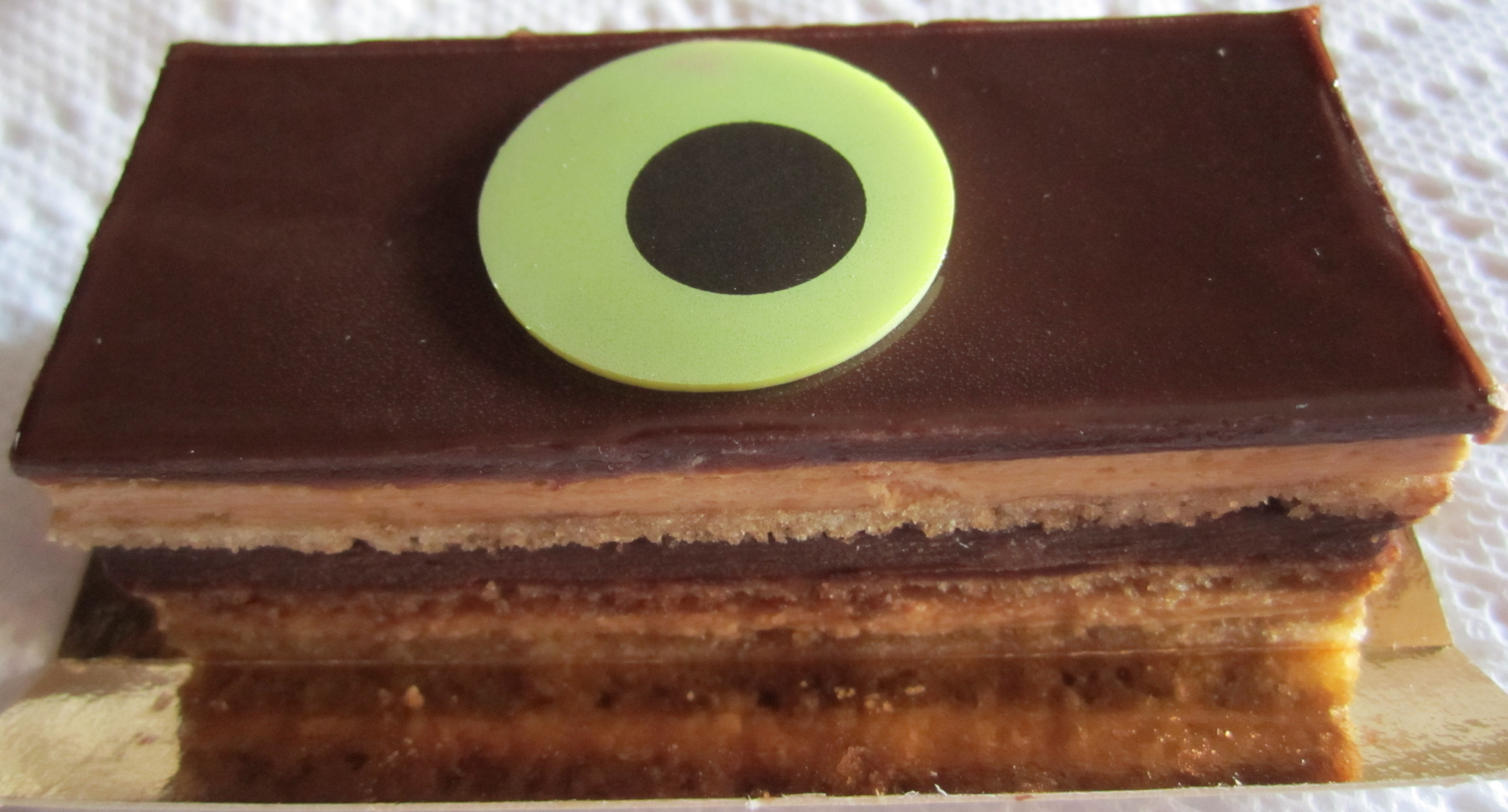
Chocolate Opera Cake from Michel Cluizel - with a pleasantly strong coffee flavor

Chocolate Opera Cake from Michel Cluizel – with a pleasantly strong coffee flavor

The Biscotti Project: The Start of an Artisanal Biscotti Business

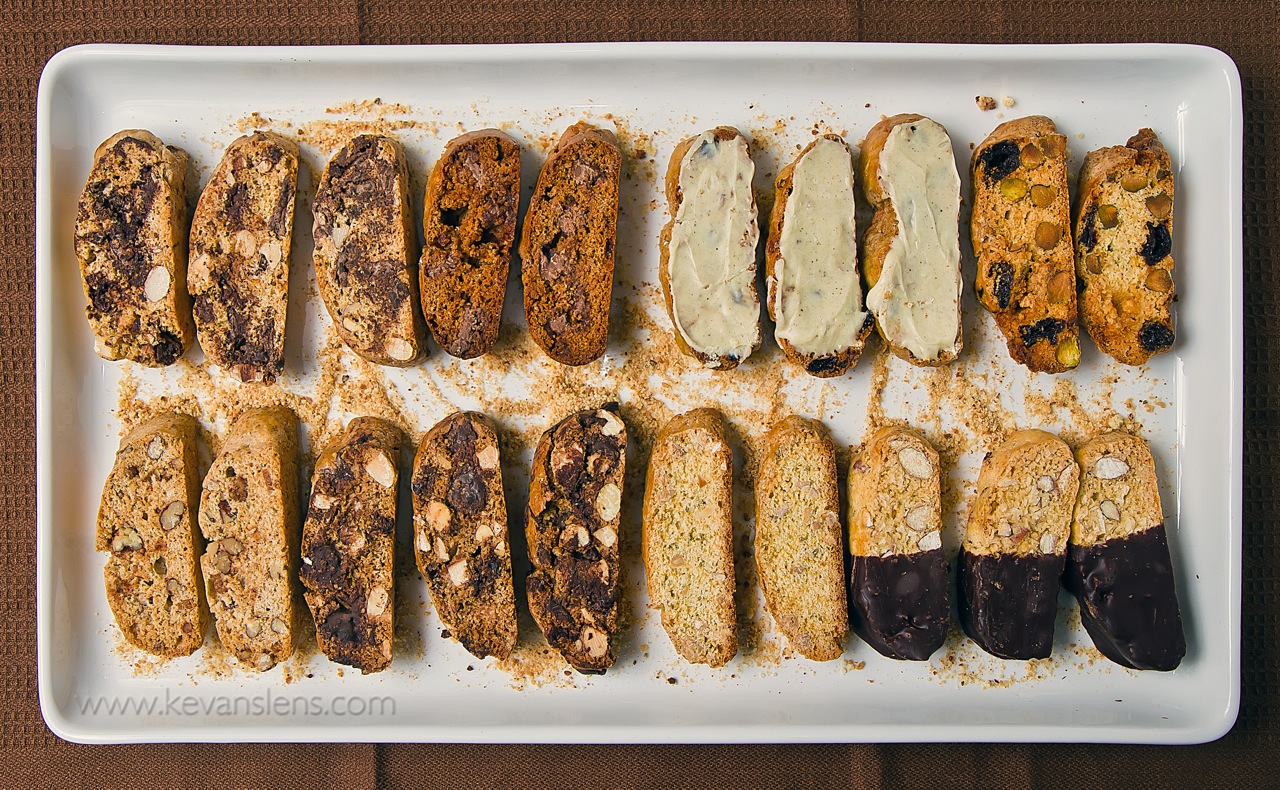
Trish Lobenfeld's Biscotti

Trish Lobenfeld’s Biscotti

I first met Trish Lobenfeld (http://www.cookinginconnecticut.com) at this year’s Roger Smith Cookbook Conference.  At a conference session devoted to showcasing new cookbook and food apps and ideas, she presented her “biscotti project.”

She’s always loved biscotti, but her attempts at creating biscotti led to what she thought were less than optimal results — the biscotti were too crumbly.  As a culinary professional who teaches and develops and tests recipes, she was convinced great biscotti were possible.

After research and development and tweaking, she perfected a biscotti recipe. The biscotti had a nice “snap” and were not overly sweet. After mastering the basic recipe, Trish was hooked and began experimenting with all sorts of different biscotti flavors and varieties. 

At the Roger Smith Cookbook Conference Trish had samples of some of her biscotti.  I tried the Peaches & Cream Biscotti, which I have to say, were excellent.

She presented at the Cookbook Conference in order to help clarify what her next steps should be to launch a biscotti business.

I sat down with Trish six weeks after the Cookbook Conference to find out what progress she’s made with the biscotti business.

These are her updates:

— To date she’s developed recipes for 29 sweet biscotti, 4 savory biscotti, and 2 gluten-free biscotti.  Some of the more intriguing sounding flavors include:

          — Carrot Cake Biscotti Dipped in White Chocolate

          — Cherry, Pistachio & Vanilla Bean White Chocolate Biscotti

          — Pumpkin, Walnut & Dark Chocolate Biscotti

          — Candied Lemon, Almond & White Chocolate Biscotti

          — Chocolate –Covered Strawberry Biscotti

          — Mango & Toasted Coconut Biscotti

          — Red Velvet Dipped in White Chocolate Biscotti

          — Basil Pesto Biscotti

          — Peanut Butter & Chocolate Biscotti (gluten-free)

 — She’s exploring an arrangement with a food production facility and will begin scaling up her recipes for production of larger batches

— She started identifying local stores and restaurants who might be interested in carrying her biscotti

—  A cookbook deal may be in the works.  And she’ll have gluten-free recipes available for all of her biscotti.

We’ll check back with her to see how the business is progressing.

Passion Fruit in Desserts

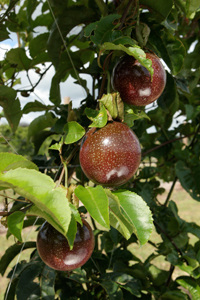
Passion Fruit on Vine

Passion Fruit on Vine

Lately I’ve been noticing passion fruit-based desserts.  Passion fruit makes its very interesting presence known in gelato, sorbet, ice cream, chocolate, macarons, tarts,  and even as a glaze over doughnuts.Why would passion fruit be used in desserts?  It has an assertive and intriguing sweet-tart flavor.  Passion fruit pairs beautifully with ice cream and cream, chocolate, and other fruits such as mango, orange, and banana. And since it’s grown in warm climates (and is native to South America), passion fruit-based desserts can make us feel as though we’ve escaped to the tropics, even if the trip lasts for just a few minutes.

I thought passion fruit was only very recently used in desserts, but that’s not the case.  Jon Snyder of Il Laboratorio del Gelato, a high-end, producer and retailer of unique flavors of gelatos and sorbets, told me that he’s been in business for almost 11 years and has been offering passion fruit sorbet and  gelato for 10 years.  Another ice cream purveyor, Gaby’s Farm, in South Florida, has been offering passion fruit ice cream and sorbet even longer – since 1999.  Her passion fruit varities now include:  Pure Passion Ice Cream, Mango Passion Sorbet, Manago Passion Melange Ice Cream, and Passion Sorbet. What differentiates Gaby’s Farm from other ice cream vendors is she grows her own fruit.  Gaby Berryer said passion fruit is the main crop at her farm and it’s hand pollinated.   

There is interest in passion fruit desserts. A web search of “passion fruit desserts” brought up over 3 million hits.  Earlier this year, Tootsie Roll Industries added a passion fruit flavor to its Frooties (soft chewy candies in fruit flavors) line.  And Olivier Dessyn of Mille-Feuille, a high-end Manhattan bakery specializing in macarons and napoleans, notes that he has offered passion fruit macarons since he’s opened and this flavor macaron is a best seller.    

And the increasing interest in Latin American cuisine also bodes well for the continued popularity of passion fruit desserts.

Amella Cocoa Butter Caramels: Passion Fruit

Amella Cocoa Butter Caramels: Passion Fruit

But what could negatively impact the popularity of passion fruit-based sweets?  The lack of familiarity with passion fruit.  Amella, a producer of artisan cocoa butter cararmels, introduced passion fruit into its line in 2009.  However, Amella recently eliminated the passion fruit variety due to poor sales.  (I’ve purchased these Passion Fruit Caramels and think they’re delicious; I’m sorry they will no longer be available.)  Emir Kiamilev of Amella notes:  “I don’t think passion fruit will be a very popular ingredient in chocolates because many people don’t know what a passion fruit is, and therefore will never even try it.”It is probably the more adventurous eaters, willing to sample exotic foods, who are driving sales of passion fruit-based desserts.  Another macaron bakery, La Maison du Macaron, reports that its passion fruit macarons are popular.  Yet, for this bakery, passion fruit macarons seem quite tame when compared with some of its other sophisticated macaron offerings – cassis, strawberry mint, rose, and kir royale.

Of course, like other crops, natural disasters can wipe out passion fruit production.  (Thanks to Melissa Hunt of the Florida Department of Agriculture and Consumer Services who provided great background information on the tropical fruit industry in Florida.)

Passion From Tart from FP Patisserie

Passion From Tart from FP Patisserie

But as someone who has recently become a fan of passion fruit in desserts, I certainly hope these desserts will be available for a long time!

Mango Passion Melange Ice Cream from Gaby's Farm

Mango Passion Melange Ice Cream from Gaby’s Farm

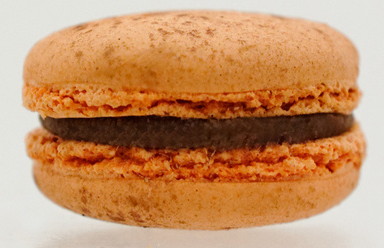
Passion Fruit/Milk Chocolate Macaron from Mille-Feuille Bakery Cafe

Passion Fruit/Milk Chocolate Macaron from Mille-Feuille Bakery Cafe

Desserts with Olive Oil

I was very saddened by the sudden death, from a massive heart attack, of a colleague who was also a friend.

That led me to start thinking about “healthier desserts” – or at least, desserts with heart-healthy fats.  Of course, one could argue that it’s not healthy to consume a lot of sugar, but for now I’m focusing on fats.

I started wondering why olive oil, the oil with the highest percentage of healthy monounsaturated fat, wasn’t the “fat ingredient” in more desserts.  After reviewing dessert cookbooks, I identified these reasons – there may be more.

  • Unlike butter, olive oil does not aerate when mixed together with sugar so baked goods with olive oil (or any oil) as the only fat, will have an uneven, coarse texture
  • As olive oil has a pronounced flavor, it may overpower desserts with milder flavors

But can’t olive oil still be used?  What if you don’t mind a dessert with a coarser texture?  What if you either love the taste of olive oil (as I do) or are combining olive oil with strongly flavored ingredients, such as citrus?

Olive oil being poured

Olive oil being poured

Olive oil companies certainly tout the health benefits of their oils.  Could they be doing more by promoting their products as a way of making desserts healthier?  I looked at the web sites of six olive oil producers, and this is what I found:Sample recipes were included on all the sites

If olive oil companies wanted to capitalize more on the market for dessert, would they encourage their loyal customers to start baking or would they encourage bakers to switch to olive oil?  While it’s often more difficult to obtain new customers (as opposed to selling more to your existing customers), it might be harder to encourage non-bakers to start baking.

Interestingly, there are at least two olive oil baking cookbooks on the market.  I own one – Olive Oil Baking by Lisa A. Sheldon.  I’ve made the Apricot Bars recipe numerous times.  While the bars might be a bit heavier than those made with butter, they’re delicious and always a big hit.

Notes from The Roger Smith Cookbook Conference

The Roger Smith Hotel in NYC - site of the Cookbook Conference

The Roger Smith Hotel in NYC – site of the Cookbook Conference

Who would think a conference exists that’s devoted solely to cookbooks? It does, and in fact the conference content is diverse enough to warrant different tracks.  One track focuses on the cookbook industry and delves into the impact of new media/social media on traditional cookbook publishing. The other track is devoted to food history & culture — and more specifically, the history of cookbooks.

A very interesting conference session was “Trendspotting in the Food Space.” Here are some of the more intriguing points from this session:

Joe Yonan, Food/Travel Editor, The Washington Post:

  • A food “trend” is a “fad” if we don’t like it.  So, if we don’t like cake pops (small pieces of cakes on sticks) we’ll be more likely to think they’re passing fancies.

Terry Newell, President, Weldon Owen (a book publisher):

  • In order for a book publisher to be able to monetize a food trend, this trend has to be well established.  Therefore, you wouldn’t publish a book devoted to a food, if this food only appeared on upscale restaurant menus.  However, when retailers such as Williams-Sonoma and Sur La Table start stocking bakeware/cookware for a specific food, you know the time is ripe to offer a cookbook devoted to this food.  And when Bed, Bath & Beyond and Target start carrying this bakeware, you know the food trend is very well established.

Addie Broyles, Editor and Food Writer, Austin-American Statesman:

  • While food trends are very important, don’t overlook other food stories.  Sending out a request for recipes for pfeffernusse (very small and round Northern European spice cookies –not the latest food trend), on behalf of a reader, led to a very compelling column about what these spice cookies mean to a reader’s family and to the impact of World War II on this family.  Of course, pfeffernusse recipes were also part of this column.

Another interesting session was “Bowker Cookbook Study: Who Buys Cookbooks and in What Format?”  Bowker is a company that serves the book industry and conducts market research studies analyzing purchases of books, including cookbooks.  Some interesting cookbook facts:  In 2012 2,707 cookbooks were published and this number includes e-books.  If a book was published in both print and e-book formats, it was counted twice. As of the 3rd quarter of 2012, 70% of cookbook buyers were female.  And, as compared with purchases of all book types, cookbook purchases were more likely to be impulse purchases.

A few dessert-oriented points, gleaned from other conference sessions:

  • Cookbooks in the 19th century were filled with recipes for desserts.  Middle-class women were expected to prepare desserts themselves, even if they had staff preparing the rest of the meal.
  • The determination of what’s “exotic” depends not just on class, but also on geography.  A dessert considered “exotic” in Iowa might be thought of as more mainstream in New York City.
  • Even when middle-class Indian people in this country cook a traditional Indian meal for their guests, dessert is more likely to be “American” than Indian.

Food Markets in Manhattan: Part 1: Chelsea Market


The Chelsea Market from 9th Avenue

The Chelsea Market from 9th Avenue

It may sound awful, but I’m sorry the tourists, tour buses, and food tours have discovered Manhattan’s Chelsea Market.   (This food mecca’s tenants are mainly manufacturers or wholesalers who locate their small retail stores/stalls here.)  My trips to the Chelsea Market to purchase big cookies from Amy’s Bread, fish from the Lobster Place, or chocolates from Jacques Torres, have to be early in the morning to avoid the crowds.  And it’s not just that there a lot of people – there are a lot of camera-toting folks who walk three or four abreast in the narrow curving hallway of the Market and suddenly stop short to snap photos of the Market’s unusual waterfall. 

I can understand why the Chelsea Market attracts tourists.  I’m sure they’re captivated by the Market’s quirky layout, thrilled that the Food Network is based upstairs, and charmed by the market’s history.  The Chelsea Market is part of the complex where The National Biscuit Company’s ovens turned out Oreos, Vanilla Wafers, Fig Newtons, and other goodies. 

Inside the Chelsea Market

Inside the Chelsea Market

What I sometimes wonder if why so many “locals” shop there.  While Manhattan supermarkets often have somewhat meager offerings, chains such as Whole Foods, Trader Joe’s, Fairway, and even Costco (one store in Manhattan!) make sure Manhattanites have plenty of food choices.  I’m sure the Market’s proximity to the Highline – the abandoned elevated railroad tracks turned into a very popular urban park – doesn’t hurt.The definition of a market is a concentration of stores.  It’s this concentration that attracts shoppers. And the Chelsea Market’s stores are particularly unique. Hankering for cookies and bread from Amy’s Bread? The whole Amy’s Bread “chain” consists of only three locations.  Need Italian specialty food products?  Buon Italia’s only location is in the Chelsea Market. 

I know it’s the unique stores and tasty offerings that draws me to the Chelsea Market, even though the Market is not very convenient to where I live.  And that’s probably the attraction for other New Yorkers.     

Since this is a dessert-themed blog, I would be remiss if I didn’t mention my favorite sweet treats from the Chelsea Market. 

I’m particularly fond of the “White Chocolate Cherry Chunker” cookie from Amy’s Bread.  And from Jacques Torres Chocolates, my favorites are the “Love Bug” – a white chocolate square enclosing a key lime filling and the milk chocolate “Coffee Break” bar.  To make sure you have enough of a caffeine buzz, this bar combines chocolate with coffee. mini_coffee-break-single_1_1